A new way to do science
Most people still picture science as a person in a white coat, pipette in hand. That image is stubbornly accurate. Even in 2025—after decades of lab robots, high‑throughput screening, and cloud computing—the overwhelming majority of experimental work is still done by hand at the bench. The result is that the “limiting reagent” for progress on everything from new materials to cancer therapeutics is not ideas or data analysis. It is the slow, manual generation of high‑quality experimental data.
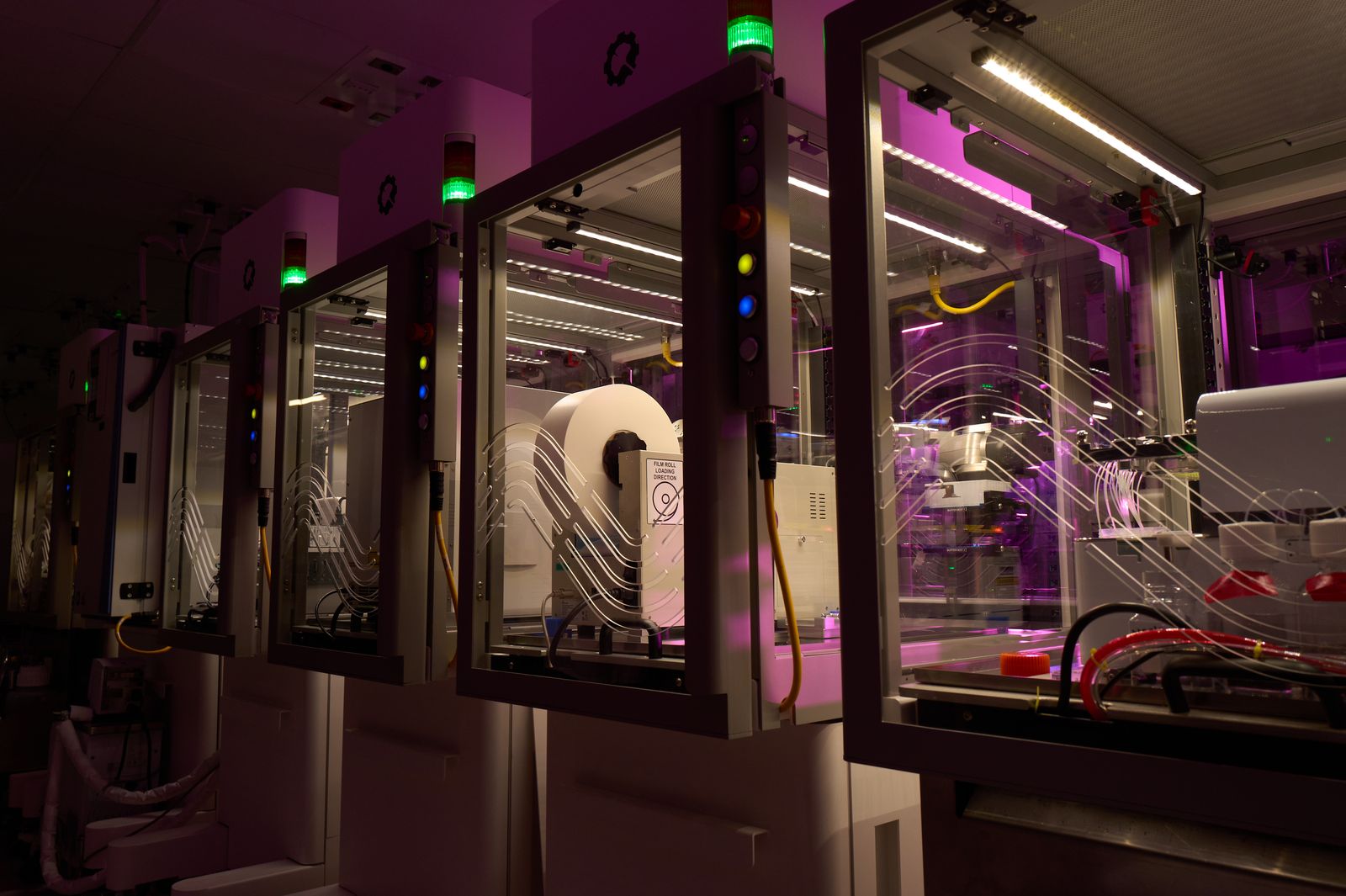
That bottleneck is why autonomous laboratories matter to everyone, not just to scientists. When we talk about “autonomous labs,” we are really talking about a new way to do science: one where scientists can order automated experiments just by asking for them. The U.S. Department of Energy’s new Genesis Mission, which tasks the national labs with building an AI‑driven discovery platform that links supercomputers, scientific datasets, and autonomous experimentation, is a clear signal that this shift is now national strategy, not science fiction.1
1. Why autonomous labs matter for everyone
For society, the promise of autonomous labs is straightforward: more and better science, faster.
In energy, autonomous labs can accelerate the hunt for better batteries, catalysts, and materials for fusion and advanced nuclear systems by running 24/7 experimental campaigns that would take human teams months or years. In health and wellness, they can help us explore vast design spaces of biologics, cell therapies, microbiome interventions, and small‑molecule drugs, systematically mapping efficacy, safety, and manufacturability. In agriculture and consumer products, they can enable rapid prototyping of everything from alternative proteins to greener surfactants.
Under the hood, many of our biggest challenges are experimentally intensive. Models and simulations are improving quickly, but in biology and materials science we are still far from a world where computation alone can replace wet‑lab validation. Closing that loop—between hypothesis, experiment, data, and the next hypothesis—is where autonomous labs shine.
Scientists themselves are asking for this shift. In a recent community survey on automation and autonomy in materials discovery, Hung and colleagues2 found that a majority of experimental researchers wanted to automate the rate‑limiting steps in their workflows, and more than a quarter said they would be comfortable automating their entire scientific workflow. Reservations were driven less by fear of “robots taking jobs” and more by practical concerns: the difficulty of integrating equipment, worries about flexibility, and the effort required to build and maintain custom systems.2

Importantly, none of this is about replacing scientists. It is about freeing them from the bench so they can spend more time doing what humans are uniquely good at: defining important problems, inventing new concepts, interpreting ambiguous data, and making consequential judgments about risk, safety, and ethics. An autonomous lab is best thought of as a new kind of scientific instrument—one that happens to be the whole lab.
2. Why lab robotics never conquered the bench
If automation has been around since the 1980s, why are most researchers still manually pipetting? The robotics literature from that era reads strikingly contemporary. Papers with titles such as “The role of robotics in the laboratory of the 1980s”3 and “Laboratory automation: a challenge for the 1990s”4 anticipated many of today’s themes: pressure to increase throughput, reduce costs, and integrate instruments and information systems. Yet outside of large clinical and industrial facilities, the routine work of discovery science remains largely artisanal.
The core reason is that we build automation, not autonomy.

Traditional lab automation is excellent at running a pre‑defined protocol over and over. A high‑throughput screening system that can test millions of compounds against a well‑specified assay is a triumph of automation. But it is also narrow: if you change the assay, the plate layout, the container types, or the upstream sample preparation, you often have to re‑engineer the system. Each new workflow becomes an integration project.
Autonomy, by contrast, is about decision‑making and adaptation. In autonomous vehicles, the widely used six‑level framework runs from Level 0 (no automation) to Level 5 (full driving automation). The leap from automation to autonomy is not just more actuators; it is a system that can perceive its environment, reason about options, and change its behavior on the fly—with humans delegating more of the “driving task” to software.5
Laboratories face a similar distinction. Most research labs are “high mix” environments: the combination of instruments, sample types, and protocols may change daily. Focusing purely on throughput works well for a single, standardized assay, but it does not solve the real problem for scientists, which is flexibility and adaptability as they deal with the messy reality of experimental science. Surveys of researchers highlight exactly this tension: they want to accelerate their rate‑limiting steps, but they worry that existing automation is brittle, hard to reconfigure, and expensive to maintain as science evolves.2
This is why so many automated systems sit underutilized in the corner of a lab. They were optimized to run one or two workflows at very high speed, not to serve as a general‑purpose platform. To truly make experimental science easier to do, we need laboratories that are programmable at the level of scientific intent (“measure how this enzyme behaves across these conditions”) rather than at the level of low‑level commands (“move this pipette tip from A1 to B3”).
That is the shift from automation to autonomy.
3. A roadmap: six Levels of Laboratory Autonomy (LoLA)
Getting to a world where scientists can retire their pipettes will not happen overnight. As with autonomous vehicles, it helps to think in stages. Inspired by both the automotive levels of autonomy and emerging academic frameworks for “self‑driving labs,” we can talk about six Levels of Laboratory Autonomy—LoLA, for short.6

Level 0: No Autonomy
Level 1: Narrow Lab Automation
Key Technical Gates: Automation hardware & software capable of conducting a single protocol end to end without human monitoring.
Level 2: General Lab Automation
Key Technical Gates: Automation hardware & software capable of conducting 10s of different protocols simultaneously without human monitoring.
Level 3: Conditional Autonomy
Key Technical Gates: Human-language AI agents + protocol debugging software allow the transfer of experimental plans to the Autonomous Lab without human programming or experimental debugging of protocols.
Level 4: High Autonomy
Key Technical Gates: AI agent that can analyze scientific literature, evaluate previous data, and make an experimental plan to submit to the Autonomous Lab.
Level 5: Full Autonomy
Key Technical Gates: Autonomous Lab that can handle the large majority of possible experimental plans in a scientific domain (such as biotechnology). Requires 100+ pieces of lab equipment in a single lab setup.
Enormous value will be created well before we reach Level 5
Moving from Level 0 to Level 2 can eliminate large fractions of repetitive bench work; Level 3 lets scientists “speak science” instead of “speaking robot”; and Level 4 and 5 have the potential to compress multi‑year projects into months, as early self‑driving labs in chemistry and materials science are already beginning to demonstrate.7
For companies like Ginkgo Bioworks, which grew up designing DNA and engineering living cells, our focus on autonomous labs reflects a simple belief: the most powerful way to make biology easier to engineer is to make the lab itself programmable. If we get this right, the average person may never see the robots, AI agents, or cloud infrastructure doing the work. What they will see are its consequences: cleaner energy, better medicines, more resilient supply chains, and a generation of scientists whose time is spent less on moving liquids and more on moving ideas forward.
References
[1] U.S. Dept. of Energy, Genesis Mission: A National Mission to Accelerate Science Through Artificial Intelligence. [Online]. Available: genesis.energy.gov.
[2] L. Hung et al., “Autonomous laboratories for accelerated materials discovery: a community survey and practical insights,” Digital Discovery, vol. 3, pp. 1273–1279, 2024. doi: 10.1039/D4DD00059E.
[3] J. N. Little, “The Role of Robotics in the Laboratory of the 80s,” J Res Natl Bur Stand (1977), vol. 93, no. 3, p. 191, Jun. 1988. doi: 10.6028/jres.093.016.
[4] C. Mordini, “Laboratory automation: a challenge for the 1990s,” J Automat Chem., vol. 16, no. 4, pp. 125–129, 1994. doi: 10.1155/S146392469400012X.
[5] Synopsys Editorial Staff, “The 6 Levels of Vehicle Autonomy Explained,” Synopsys Automotive Blog, Feb. 15, 2025. [Online]. Available: https://www.synopsys.com/blogs/chip-design/autonomous-driving-levels.html.
[6] Nat’l Highway Traffic Safety Admin. (NHTSA), The Six Levels of Vehicle Automation. Washington, D.C.: U.S. Dept. of Transportation, May 25, 2022. [Online]. Available: https://www.nhtsa.gov/sites/nhtsa.gov/files/2022-05/Level-of-Automation-052522-tag.pdf.
[7] R. B. Canty et al., “Science acceleration and accessibility with self-driving labs,” Nat. Commun., vol. 16, no. 1, p. 3856, Apr. 2025. doi: 10.1038/s41467-025-59231-1.

Build your own autonomous lab